Category Archives: Stories

Desert Surfboarding


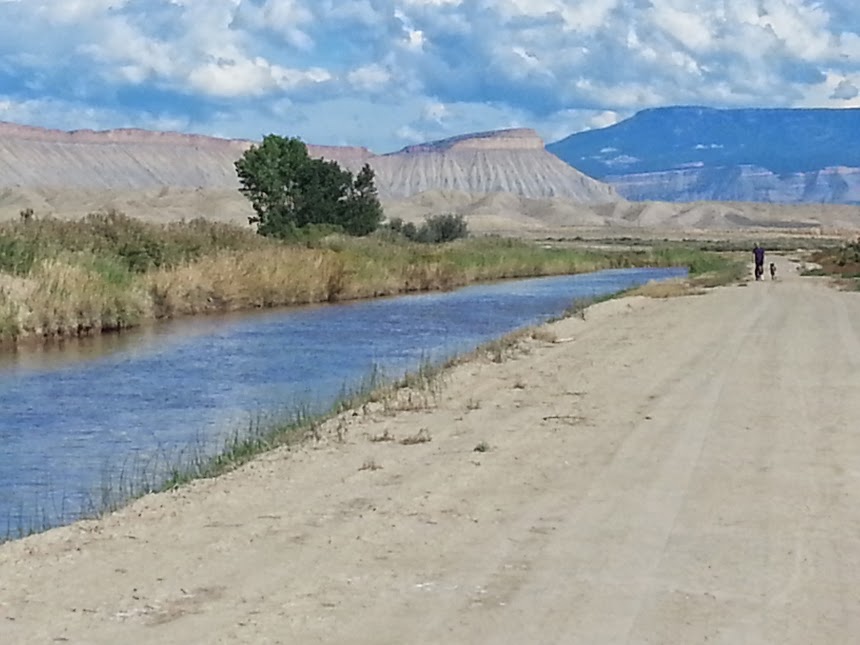
CanalShot3

The Grand Valley Canal Near Grand Junction, Mt. Garfield and Grand Mesa in the Background

I am a child of the desert.  Fruita, Colorado has no more than eight inches of annual rainfall.  Growing up in the late 1950’s, we were surfers before the Beach Boys made surfing famous.

The Grand Valley of Western Colorado is irrigated farm country.  Two big canals bring Colorado River water to the valley farms.  One of those canals had a place we called Karp’s Hole, after a nearby farm family.  The hole was created by a concrete flume, narrower than the rest of the ditch, that created turbulence and eddy currents downstream that excavated a deep hole about 50 feet wide that was perfect for swimming.  There was a diving board made from a 2″x12″ plank and an old car spring.  That board was as good as any swimming pool diving board and was there for years.

With plenty of parking spaces, it was a popular summer party spot.  The water, “too thick to drink and too thin to plow”, was good for tag games.  A person could duck under and follow eddy currents to other points in the hole without being seen.  The other side was lined with willows tall enough to provide hiding places.  I had a scare when swimming in an underwater tunnel that surfaced behind the willows.  I got stuck.  My shoulders were a bit too wide, and my hands were in front.  I wriggled and squirmed for what was probably  only a few seconds, but it seemed like a long time to me before I was able to back out.

The road to Karp’s Hole ran alongside the canal for about 1 1/2 miles from the nearest county road.  Built when the canal was dug, it was used for maintenance and by the ditch riders who patrolled the canal, adjusting the head gates that sent water to the farm fields.

For surfboarding, we made 4′ x 2′  plywood boards with two ropes with a handle coming back from the front of the board to the rider standing on a piece of carpet tacked to the back of the board.  Another rope yoke led from to the bottom of the board to the tow rope which ran about 50′ to a post in the bed of a pickup truck.  The driver and a spotter were in the cab and the rest of us rode in the bed.  With the tow rope tied to a stake secured in the bed, the surfer shifted his weight from side to side and swung from one side of the canal to the other and back, sometimes bumping into the bank, and throwing a rooster tail of water onto the road.

We went about 20 miles per hour, any faster increasingly dangerous and less fun.  The sport was illegal, we were trespassing, making it even more fun, but no one ever got arrested.  After my first time at about 16, I came home and told my parents about our new sport.  My father laughed, saying he surfboarded in the 1920’s behind Model T Fords.  We were just keeping a Grand Valley tradition alive.

Our surfboarding parties were usually fueled by Coors 3.2 beer.  There was no other beer for us.  Given the muddy road, the beer, and adolescent hormones, accidents were rare.  One time, the ditch company had mowed the willows lining the canal.  Alan hit the bank with the bottom of his board a little too hard, and flew face down onto the willows.  Bright red stripes.

The worst surfboarding accident was when a girl riding for the first time hit the bank and sort of flopped.  She broke one of the bony processes on a spinal vertebra.  No nerve damage, but she sure was sore for a while.  The worst injury is when Don, my neighbor across the street dived into the shallow sand bar while drunk.   He broke his neck.  He was in a big cast from his chest to his chin and the back of his head.  To drive, he put the top down of his 1955 Chevy convertible (the envy of every guy in town), parked his butt on the seat back, leaned forward, and drove. The cops never said a word.

More than 50 years later I can remember the sensation of speed, of spray in my face, the movement of the board under my feet as I dug one corner in to make a turn, zooming across the canal and digging in the other corner as the bottom of the board bounced on the bank.  Spray flew 20 or more feet as I sped to the other bank and turned to make another run to douse the road.  It was best when I could spray another car meeting us on the ditch road.  It was usually some friends coming for their rides on the surfboard.

Water sports were big, but we had a mechanized winter sport as well.  Two brothers had what we called a toboggan that had been around for years.  It had steel runners at each corner and a deck that could hold four or five people.  After a snow we would haul it out to the desert north of the farm area and tow it behind a pickup truck, preferably four wheel drive.

No going on the road or in a straight line, the driver’s goal was to turn sharp enough to throw everyone off.  Speeds were a bit higher, close to 30 miles per hour.  At night.  There was lots of screaming and laughing as we rolled through the snow and mud.

I don’t remember anyone ever getting hurt, but we would get home tired, cold, wet, and muddy.  Parents would just shake their heads.  After all, they had done it themselves.
 

Sandstone Solitude


I like to do solo trips in the Southeastern Utah canyon country.  I began going there in the 1950’s with my parents, then with friends, and by myself.  I go there for the scenery and for the solitude.

The tourism centered around Moab has made finding solitude more challenging, but the crowds of four wheelers, dirt bikers, mountain bikers, and other rabble tend to go to the same places, leaving vast areas empty.  Even in well-traveled areas all I need to do is walk about 1/4 mile and I am alone.

Bare rock, deep canyons, intense light, vertical spires, and the starkness leads me into myself.  My mind empties of the clutter of civilization.  I return refreshed and at peace.  My trips there are pilgrimages.

There also is the danger.  All the Park Service literature emphasizes safety.  Traveling with others, taking the proper equipment, having communications, carrying water, and leaving an itinerary are all good advice.  I carry water and the 10 essentials along with nylon cord, a trowel, and a poncho or space blanket.  Sometimes I travel with others.


mgl7201

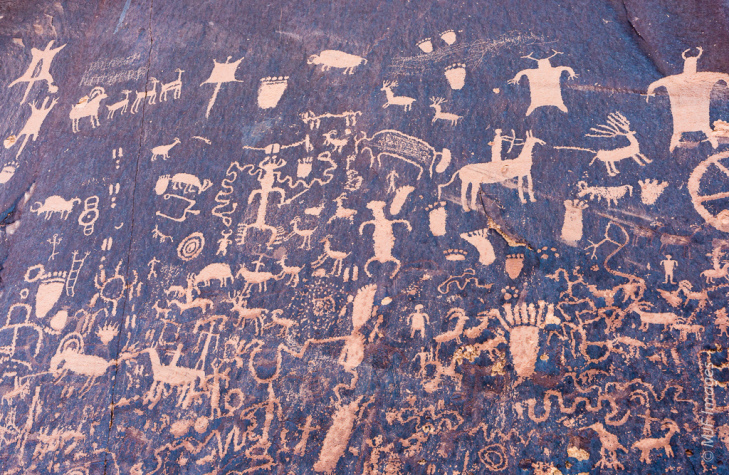
Newspaper Rock

I go into slot canyons, climb over the ridge to the next canyon where the cattle could not go, follow winding canyons to the pourover that stops me, scramble up to the rim, and ramble in the slickrock.  I look for ruins of the people who lived, hunted, and farmed here.  They left pictographs on those stone walls that tell of the hunt, of the gods.  Life must have been hard, but they were surrounded by beauty, and they had time for art.


elephant hill view

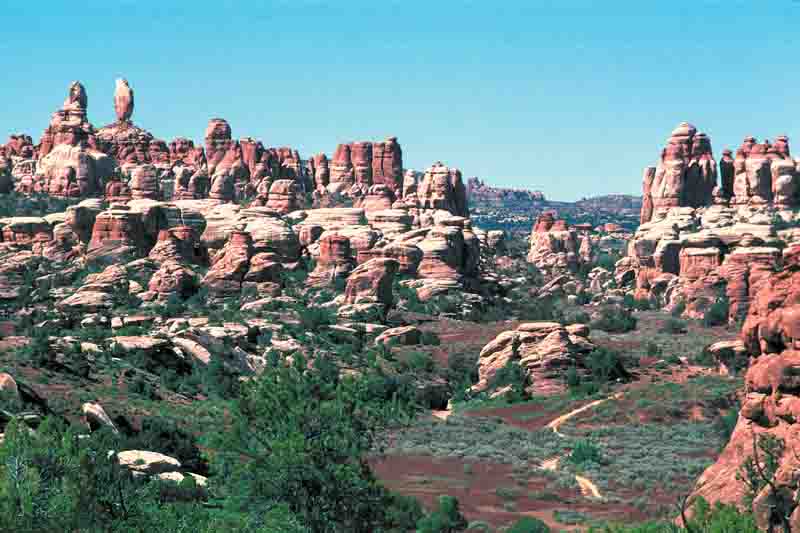
The Needles District

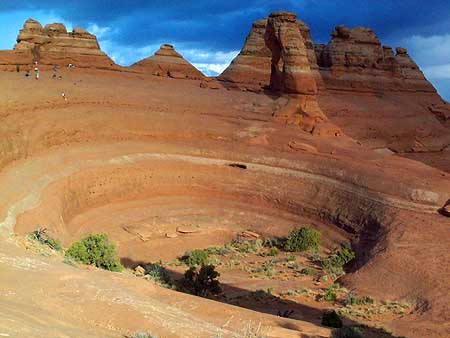
I especially like the slickrock.  Entrada sandstone, ancient sand dunes turned to stone, it has a sensual feel.  There are rounded humps, steep drops, curves and hollows, and those inviting bowls.  The bowls are the best.  In the couple of weeks after a rain they hold enough water to support life.  Tadpoles, water striders, and other insects have a brief time in the sun until the water dries up and they go dormant.  I like to drink from them when the water is fresh.


bowlThe bowls range in size from a few inches to hundreds of feet in diameter.  The larger ones have a sandy bottom, sometimes with desert vegetation.  Other bowls have an outlet, a crack or joint in the rock that is wide enough for an exit.  Many are true bowls, no outlet, with steep, smooth sides.

What is it about boys and holes in the ground?  We just want to go into them.   I do, often without a thought about how I am going to get out.  More than once I have found myself in trouble.


5162011-Devils-Kitchen-Canyonlands-Campsite

Devils Kitchen Campsite

One time I was in the Needles district of Canyonlands National Park.  There is a challenging four wheel drive over Elephant Hill; a misnomer because the hill is solid rock.  I camped at Devil’s Kitchen, an area where each campsite is under a sandstone overhang.  The view is across a park to the pinnacles surrounding Chesler Park, a magical place.

Everyone goes to Chesler Park, so the area around the campsites is little-traveled.  I climbed around for a while, seeking the high points to look west across the Colorado River to the spires and cliffs of the Maze District.  It’s a panorama of varying shades of red rock, tilted and broken into fins and spires that should exist only in the imagination, but there they are.

Hiking a bit farther east, I came across one of those bowls, a big one.  I climbed down to the sandy bottom, admiring the grasses that manage to survive in that dry place.  Rain runs off the rock and waters the edges of the sandy bottom promoting more growth there.  I looked around and thought, “I wonder if I can get out of here?”

My standard strategy is to walk up the sides of the bowl using the friction of my shoes.  Too steep.  I tried a running start.  Failed.  I went as high as I could standing, then scrambled on all fours, feet slipping and using my knees as well. By that time I was worried.  No cell phone service there, so I was on my own.  It took several tries, losing some skin and good blue denim, but there is no skeleton in that bowl.  I will go back, but plan to stay out of the bowls.

Teek’s Hot Rod

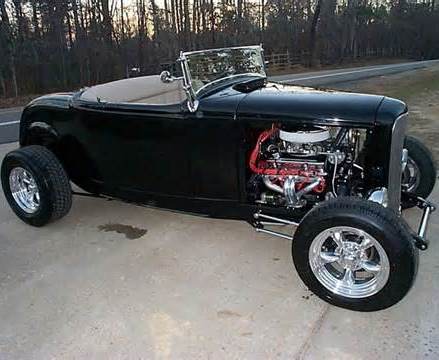
hot rod 3It’s 1958, and fast cars are what we wanted.  Teek, my classmate with a funny nickname, found a Ford Model A roadster body and frame, but needed everything else and had little money.  He heard about a wrecked 1954 Oldsmobile with a good engine at the bottom of a canyon.

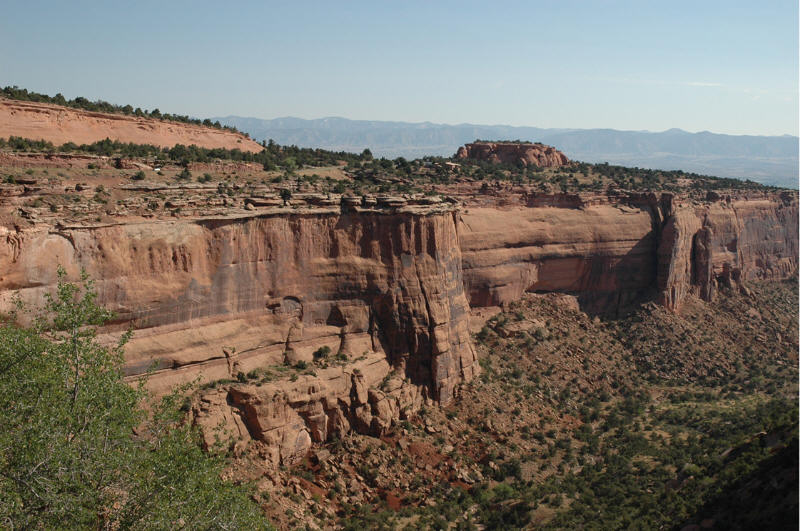
We’re in Fruita, Colorado, a town of 1800 people a long way from most anywhere.  South of town is the Colorado National Monument, an area of striking sandstone canyons traversed by roads bordering the canyon rims.


CanyonSomeone had decided to get rid of his car by rolling it over the canyon rim just outside the Park boundary.  Teek heard about it and decided to salvage the engine in the wreck at the bottom of a 200 foot high cliff.  That called for creativity and a lot of help.  He and some of his gearhead friends climbed into the canyon and disassembled the engine as much as they could.

They packed the smaller parts up out of the canyon with only Jerry smashing a finger falling while carrying a cylinder head.  Next, how to get that big cast iron engine block out of the canyon.  One Saturday, about ten of us assembled at the canyon rim.  Teek had taken the rubber tire off a wheelbarrow wheel and bolted the wheel to a long 4″x4″ piece of lumber.  We poked it over the sheer rim, weighted the back end with some big rocks, and ran a 1/4″ hemp rope through the pulley and into the canyon.

Thankfully, I was not involved in wrestling that big block from where the car had rolled to under the rim.   With the rope tied to the engine block, all we had to do was pull.  That block probably weighed 400 pounds.  We pulled.  And pulled. And complained. And pulled.  The little rope slowly unwound as we pulled, and we worried it would break.  It sure looked skinny.

It took most of an hour with hands and muscles complaining, but we got it to the rim and dragged it to level ground.  Teek had a motor for his roadster!

A few months later we showed up at his house out in the farm country north of town.  The car was running, sort of.  The motor was in, transmission and running gear installed, and it was loud.  No exhaust system, no gas pedal, just a wire coming back from the carburetor, and no starter.  The cooling system was two hoses jammed together and filled with irrigation water.  Oh, no seat, just a board laid on the frame rails for seating and to hold the battery.  No fenders, of course.

Teek and another guy sat on the board, he had one hand on the wheel, the other on the throttle wire.  Three of us laid on the trunk lid of the roadster body with our feet on the bumper of the pickup truck start vehicle behind us, and the pickup driver started us moving. The Olds engine fired up, and off we went.

I have had fast cars, motorcycles, and flown, but never had such a sensation of pure speed as roaring down those country roads lying on the back of a roadster trying to keep from being bounced off.  We would go until the engine got hot (no radiator, remember?), stop, pull the hoses apart and fill it with ditch water, push start again, and fly!

Never again have terror, joy, excitement, and sheer speed come together like that day.

High school graduation came and I moved on.  Teek finished his car and drove it for years, but I never got a ride in the finished model.  We talked about those days at our 50th reunion, and the memory is still fresh as the day we broke lots of  laws riding on Teek’s hot rod.

The pictures are not of Teek’s hot rod or of the canyon the motor came out of, but are good representations.

Wild Night

We graduated high school and spent the summer hanging around Fruita before starting our new lives.  Most nights we met at the pool hall and went to Grand Junction for a movie, drove around drinking beer, or shot pool.

We saw Joe park his old Power Wagon and walk in.  He said, “I twisted off from my roughnecking job down at Moab and have to pick up my gear.  Lee, I’ll buy the gas and beer if we can go in your Mercury.  My Wagon isn’t too happy over 35.”

“Sure.” Lee said.  “We can run down there and be back before midnight.  Ought to be fun.”

Joe said, “Do you guys want to come along?” to Ed and me.  We headed for Lee’s nice ‘56 Mercury and piled in.   Joe bought a case of Coors bottles for the trip.  We threw the empties at road signs.

It was 100 miles to Moab then fifteen miles of dirt road to the drill rig with Joe’s stuff.   After an hour and a half and most of the beer we turned onto the narrow dirt road.  It followed the Colorado River downstream in a canyon with sheer sandstone walls on one side and the river on the other.

We made it to the rig, Joe got his gear, and we headed back to Moab.  About half way there, Joe yelled, “Stop!  There’s a Ring-tailed Cat.”

The Ringtail, as it is now called, is a member of the raccoon family, lean and leggy for nocturnal hunting in its desert habitat.  He was between the car and the cliff wall, with a little scrub to hide behind.

“I’m going to get that sucker.” Joe said as he took some heavy work gloves and jumped out of the car.   The cat tried to go up the sandstone wall and Joe lunged for it.  He tied into a fury of teeth and claws.  The cat left and Joe bled.

Ed cleaned Joe’s bites and scratches with the last of his beer and we headed home.  After lots of laughs and very little sympathy for Joe’s wounds, we all settled into the ride.

Lee was fairly drunk, but no more than the rest of us, so he drove all the way, nodding a bit.  We were about three miles from town and Ed said, “Well, I’ve had enough excitement for one night…look out!”  He had seen two horses in the middle of the highway.  Lee was in enough of a stupor to have not seen them, then jerked his head up and hit the brakes.

Too late.  The Merc hit them both head on.  The horses flew over the hood and struck the roof, peeling it back and spilling their insides into the car’s interior.  Ed managed to get the car stopped and we dazedly looked around.  No one was hurt, but we were all drenched in blood and the contents of the horse’s innards.

A passerby saw the accident, drove to the diner in town and called the cops.  Everyone in the café drove out to see the carnage.  As a friend from the diner walked up, Lee went over, covered in blood, stomach contents, and shit.  He said, “Can you smell any beer on my breath?”

Note: The events in the story are true, but from two events.  I have changed the names to protect the guilty.


Train Wreck

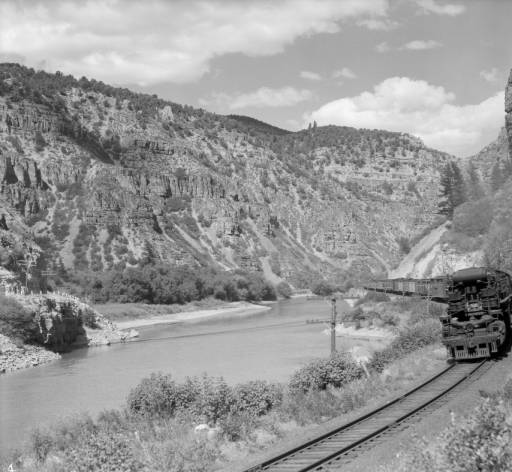
D&RG Glenwood Canyon

D&RG Glenwood Canyon

It was one of those bleak, cold January days, too cold for a heavy snow, but enough snow was flying to cut visibility to less than 100 yards.  On the D&RGW Railroad in 1924, the trains ran on train orders, instructions detailing where each train on the line was to be at any given time.  The train orders told each train when and where to pull into a passing track to let an oncoming train go by.

At 5:00 PM on January 17, 1924, Eastbound Freight #320 was to enter the Shoshone siding and wait for a westbound train to pass.  Visibility was so poor that the engineer had slowed to 15 MPH instead of the normal 20 MPH.  My grandfather Will was the rear brakeman on #320 and heard the conductor say that there was no way they could get to Shoshone and they would pull in to the passing track at No Name, just east of Glenwood Springs.

Will went out on the platform and was able to signal to the head brakeman in the engine to pull the train in at No Name.  The train lurched through the switch and stopped.  Will jumped down and threw the switch back to the main line, then the train moved along the siding to just around a bend and stopped.  This was a violation of the train orders, but not much, and the crew felt safe in stopping early.

The head brakeman was walking back to the caboose for a cup of coffee when he saw the other engine’s headlight illuminating the snow just around the curve, its wheels’ flanges squealing on the rails.

“Oh, shit.” He thought as he frantically signaled with his lantern back to the engine to start the train moving.  He ran yelling to the caboose just as Will looked out the back window and saw the headlight and realized the coming train, brakes squealing and whistle screaming, was going to hit them.

“Run forward!” Will yelled at the conductor as he started to climb the ladder up to the cupola, thinking to get above the impact.  The train’s engine struck the wooden caboose and the back half splintered, breaking a steam line on the engine.  The steam rushed into the wreckage just as the conductor jumped out and Will’s forehead hit the ladder.

He pulled himself up, blinking blood out of his eyes, thinking “If they were going any faster, we’d be dead.”

Friday, January 25.  Will walked up the walk 729 Gunnison Avenue in Grand Junction.  Pearl met him at the door.  “Well, how did it go?”  She asked.

Will entered the parlor and sat heavily in the first chair.  “The superintendent fired the whole crew for disobeying the train orders.  We talked about the storm slowing us down, but it didn’t matter.”  He said wearily.

Pearl Comes To Colorado

untitled

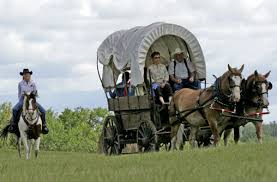
Horse Drawn Wagon

Pearl Pass 2

Pearl Pass

It is 1887 in North Texas and Lee Willits’ ranch is not doing well.  Lee applied and got a job as a ranch foreman in Colorado.  The next thing was to make the move.  With all the ranch equipment and a horse herd, he decided to travel with wagons.  His daughter Pearl drove one of the wagons.

They travelled from Texas into New Mexico, then north into Southern Colorado and Taylor Park, where Crested Butte is located.  The task then was to get over the Elk Mountains to Aspen and down the Roaring Fork River to El Jebel Ranch north of Basalt.

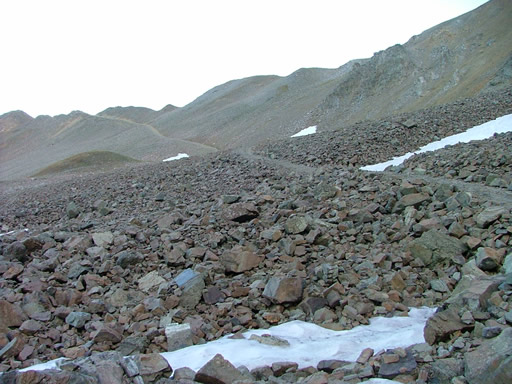
The wagon road from Taylor Park to Aspen went over Pearl Pass.  At 12,700 feet high, it was steep, narrow, and rocky.  They traveled the road with more than one wagon, the horse herd, and probably with Lee on his horse.  It is a shelf road, with the mountain rising on one side of the road and a steep drop-off into a canyon on the other.  The road sloped to the outside, and was only wide enough for one wagon.  The Willits family was not familiar with mountain roads and misjudged how long it would take to get over the pass to Ashcroft, today a ghost town outside Aspen.  They got in at 11:00 PM.

Pearl drove her wagon down that mountain road in the dark.  She was a tough kid, though, at twelve years old.  She must have been terrified, as she told that story the rest of her life.  The family settled down and Lee did well, acquiring land of his own and working it as well as the big El Jebel ranch.  Pearl, her two sisters and a brother went to Basalt schools.

As Basalt was near Aspen, an important mining town, it was served by two railroads.  A spur of the Denver and Rio Grande Western came up the Roaring Fork from Glenwood Springs; and the Colorado Midland came over the Continental Divide from Leadville via Hagerman Pass, again over 12,000 feet high.  One of the railroaders on the Midland was William Shanks, my grandfather.

Will was a conductor on the Midland, assigned his own red caboose, and in charge of the train.  He lived in Leadville, a division point on the Midland.  In the morning his train went west past Turquoise Lake, over the pass, and down the scenic Frying Pan River Valley to Basalt.  At that point, another crew took the train on to Grand Junction.  Will laid over in Basalt and took another train to Leadville the next day.

There he was in Basalt two or three nights a week, and he met Pearl, by that time a mountain girl in her own right.  After a courtship they married and she lived in Leadville with Will. They had three children; all born at the ranch in Basalt, as it was much safer having babies at 6500 feet in Basalt rather than over 10,000 feet elevation in Leadville in the days before antibiotics.  The middle of the three children was Rollin, my father.

Bad Evening

I’m in lower downtown, Denver. It’s January 12, a Friday evening and the temperature is four degrees. It hasn’t gotten above 18 degrees in a week. There are a few inches of dirty snow on the ground, sidewalks and streets are icy. Tempers are short, people irritated.
I fit right in. We were supposed to meet at the new sushi bar 45 minutes ago. The place was crowded, a line of chilled people waiting to get in. She isn’t there. I call, her phone goes right to voice mail. My feet are cold, I start worrying about frostbite on the ear that got frostbitten on Loveland Pass years ago. I wait for thirty minutes and then head for my car.
It is a bit of a walk to my car. I know a spot on Champa that doesn’t have a meter, and people seem to avoid it. I get colder as I walk. I cross the street to the bus station. Time to warm up a little. I go in. The place is crowded, others warming up, travelers coming and going. I stomp and wiggle for a few minutes, then decide to cut through the bus bay for a short cut.
I go out the door to a noisy, smelly, frigid bus loading bay. Passengers are lining up for their busses, the off-duty cop is arguing with someone over his cell phone, ignoring the surroundings. A well-dressed African-American woman is trying to usher her four children to a waiting bus in the second row.
She looks distraught, the children, ages around four to nine, look cold, confused, and scared. The driver is loading luggage, passengers groping through layers of clothing for their tickets. A man walks through the bus entrance into the bay. African-American, he is wearing a tan trench coat, dark wool trousers, wingtips, and a gray fedora. He is talking on his phone when the youngest child looks up and sees him.
“Daddy!” She cries, running toward him. He lowers the phone as he sees her. She stops in front of a bus, realizing the man is not her father. The bus starts moving, the driver not seeing the little girl. The bus hits her, knocking her down and running over her head.
Screams, panic, people running to the accident, people running away. Blood, already starting to freeze, runs out from under the bus past small, motionless feet. The mother collapses, the cop moving toward her. Quickly, firefighters and paramedics run in. I vomit.
Still retching, I walk into the waiting room and sink onto a bench. Bad evening.

Recent Entries »